
 DeltaSnap
 DriveSync
 Noject
 DeltaSync
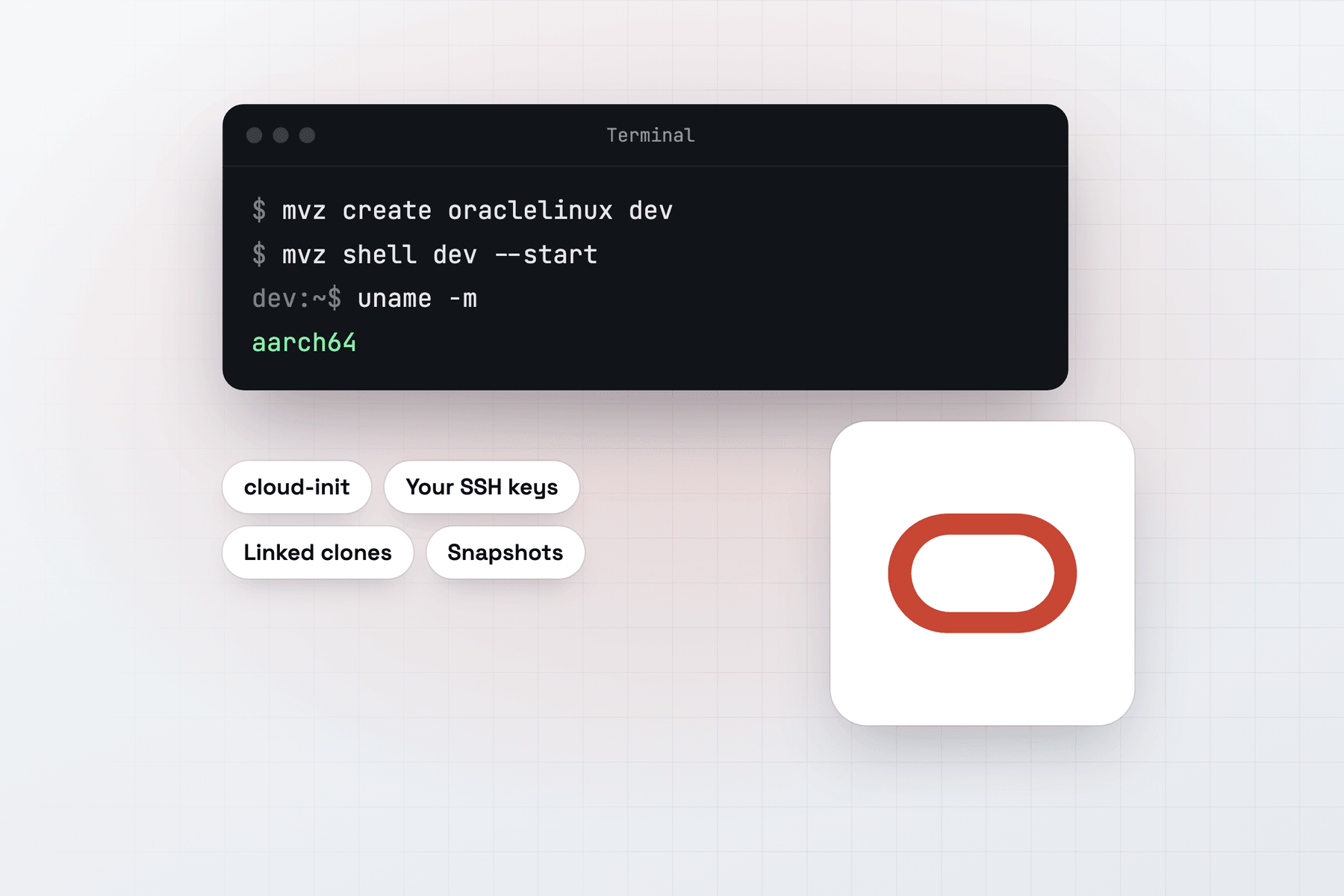
Create an Oracle Linux VM
In the app, choose New VM → Linux → Cloud Image → Oracle Linux 10. From Terminal:
mvz create oracle dev                       # Oracle Linux 10 Update 1 (aliases: oracle, oraclelinux)
mvz create oraclelinux-9 ol9                # Oracle Linux 9 Update 8
mvz wait dev --start                        # first boot: 5 to 10 minutes
mvz shell dev
The images are Oracle's aarch64 KVM cloud templates from yum.oracle.com, OL10U1_aarch64-kvm-cloud-b178 and OL9U8_aarch64-kvm-cloud-b182, each pinned to a SHA-256 digest in the signed catalogue. They're fixed builds, and MacVisor updates move them forward.
What you get
Your account has your Mac user name and UID, your SSH keys, bash and sudo without a password. The MacVisor Agent and automatic port forwarding are set up on the first boot.
Oracle Linux is RHEL-compatible and boots Oracle's Unbreakable Enterprise Kernel (UEK) by default. Use it when your production servers or a vendor's support matrix call for Oracle Linux.
What UEK changes
Most of what's different about Oracle Linux in a VM comes from UEK.
- Shared folders arrive a few minutes late. UEK keeps the virtiofs driver in
kernel-uek-modules. The MacVisor Agent installs it in the background after the first boot, which can take ten minutes on Oracle's mirrors, and mounts the shares once it's in. The New VM form says so beside the shares. See Oracle Linux mounts them a little later. - Rosetta doesn't run on UEK. The agent logs that and skips it. Boot the Red Hat Compatible Kernel when you need x86-64 programs.
- Container networking needs more modules. UEK splits the iptables modules further, and MacVisor installs
kernel-uek-modulesandkernel-uek-modules-extra-netfilterfor the running kernel when containers need them.
Containers
| Release | Offered | Not offered |
|---|---|---|
| Oracle Linux 9 | Docker Engine, Podman, containerd | k3s |
| Oracle Linux 10 | Podman, containerd | Docker Engine, k3s |
The New VM form hides runtimes an image can't run, and mvz create refuses them and lists the ones it offers. For Docker-style workflows on Oracle Linux 10, choose Podman: its Docker-compatible API is forwarded to the Mac as the macvisor-<vm> docker context.
mvz create oracle pods --runtime podman
mvz create oraclelinux-9 web --runtime docker
An Oracle Linux image you add from a file is recognised by its name, such as OL9U5_aarch64… or oraclelinux-9, and gets the same limits. See Runtimes by distribution.
Quirks
- Slow first boot. 5 to 10 minutes on Oracle's mirrors. MacVisor retries each package install three times before it reports a failure.
- XFS root. The disk grows with
mvz set <vm> --disk <GiB>and never shrinks. - If you need k3s or Rosetta on an EL system, Rocky Linux or AlmaLinux run both.