
 DeltaSnap
 DriveSync
 Noject
 DeltaSync
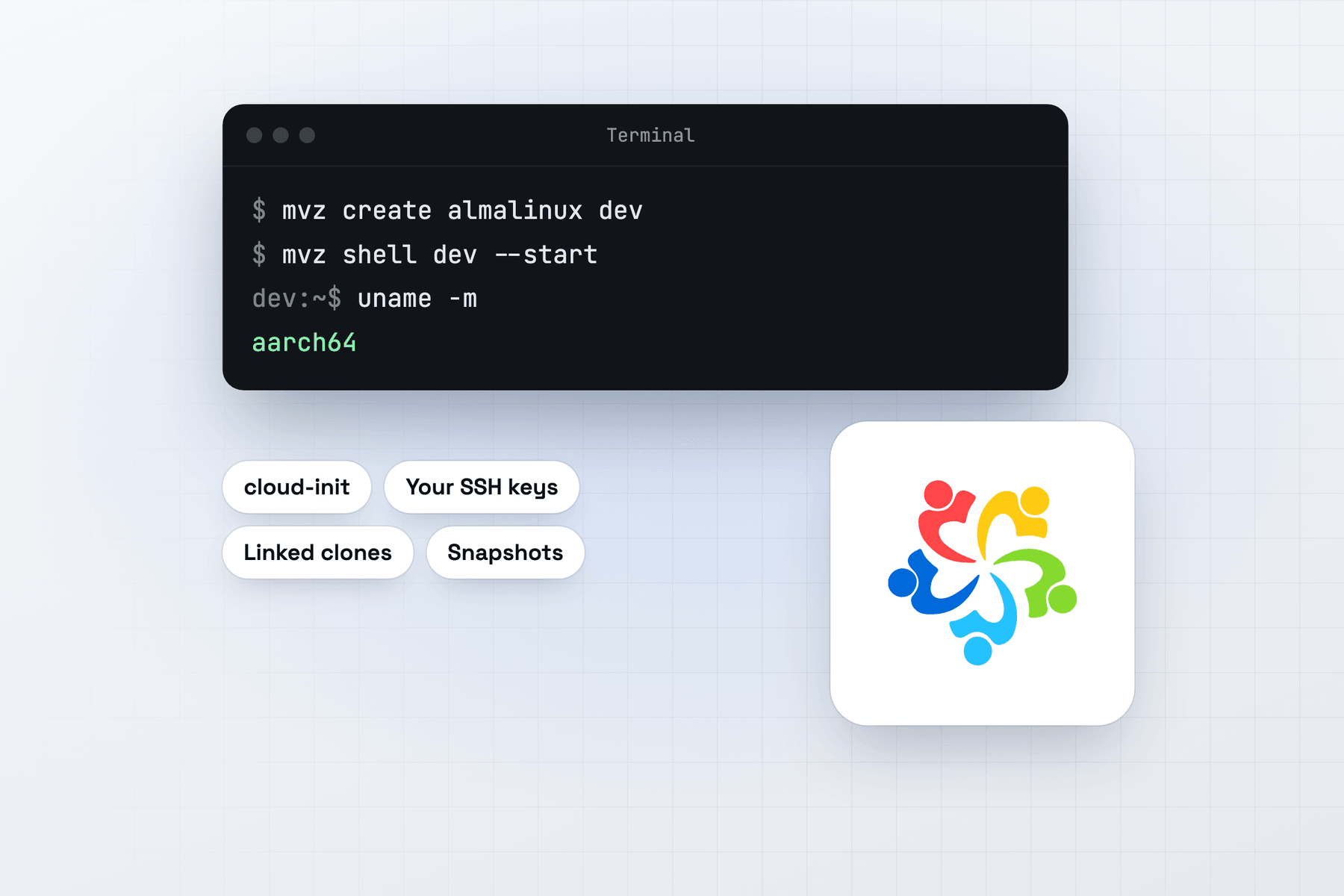
Create an AlmaLinux VM
In the app, choose New VM → Linux → Cloud Image → AlmaLinux 10. From Terminal:
mvz create alma dev                         # AlmaLinux 10 (aliases: alma, almalinux)
mvz create almalinux-9 el9                  # AlmaLinux 9
mvz shell dev --start
The images are AlmaLinux's GenericCloud-latest aarch64 builds from repo.almalinux.org, verified against the CHECKSUM file in the same folder. The catalogue tracks AlmaLinux's newest build, and mvz images pull alma fetches it for later VMs.
What you get
Your account has your Mac user name and UID, your SSH keys, bash and sudo without a password. The MacVisor Agent, Rosetta and automatic port forwarding are set up on the first boot.
AlmaLinux is a community rebuild of Red Hat Enterprise Linux. It fits when your servers or customers run AlmaLinux, or when you need an EL9 and an EL10 machine at once to build packages for both.
Two releases side by side
The first VM from each release makes a template, and the VMs after it are linked clones. That makes a matrix cheap:
mvz create almalinux-9 el9 --home
mvz create almalinux-10 el10 --home
mvz exec el9 --start --wait -- rpm -q glibc
mvz exec el10 --start --wait -- rpm -q glibc
--home shares your home folder read-only at the same path in both, so a build script on the Mac runs unchanged in each. Before a risky change, mvz snapshots take el9 --name before-upgrade keeps a point to revert to.
Containers
All four runtimes work on AlmaLinux 10 and 9.
- Docker comes from Docker's repository for RHEL (
docker-ce, with Buildx and Compose), since AlmaLinux ships Podman instead. - Podman comes from AlmaLinux's repositories, rootless, with its Docker-compatible API forwarded to the Mac.
- containerd is a rootless nerdctl setup. MacVisor installs
kernel-modules-extrawhen the kernel lacks the iptables modules containers use. - k3s runs as a single node with 4 GiB of memory or more.
Quirks
- SELinux enforcing, as AlmaLinux ships it.
- XFS root. The disk grows with
mvz set <vm> --disk <GiB>and never shrinks. - Rocky and AlmaLinux behave alike in MacVisor. The Rocky Linux page has the same steps.